Conscious Living Coach: Your Guide to Transformative Personal Growth
What if the life you keep waiting for is already waiting for you, and the only thing standing in the way is a pattern you haven't learned to see yet? That's not a rhetorical comfort. It's a diagnosis. Most people don't lack ambition or effort. They lack the clarity to recognize the invisible blueprint running their decisions, their relationships, and their results.
You already know something isn't working. You've felt it in the cycles that keep repeating, in the goals that stay just out of reach, in that persistent sense that you're capable of more but can't quite unlock it. That feeling is real, and it's pointing at something specific.
A conscious living coach doesn't just offer inspiration. They offer intervention. Working with one means getting a clear-eyed look at the limiting beliefs driving your patterns, practical tools to dismantle them, and a direct path toward the life you're actually here to build. In this article, you'll discover exactly what conscious living coaching involves, how it works, and why pairing that process with the unique insights of psychic channelling can accelerate your transformation in ways traditional coaching alone rarely achieves.
Key Takeaways
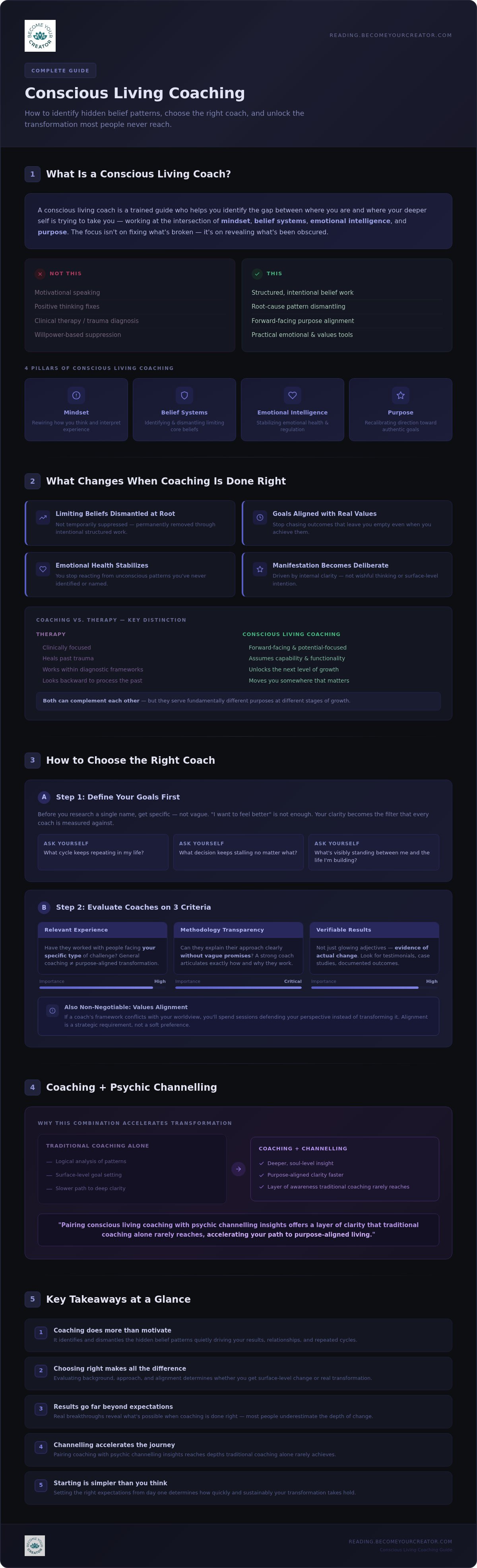
- A conscious living coach does more than motivate - they help you identify and dismantle the hidden belief patterns that are quietly driving your results, relationships, and repeated cycles.
- Choosing the right coach requires more than a quick search; knowing how to evaluate a coach's background, approach, and alignment with your specific goals makes the difference between surface-level change and real transformation.
- Real client breakthroughs reveal what's actually possible when coaching is done right - and the results go far beyond what most people expect when they first start the process.
- Pairing conscious living coaching with psychic channelling insights offers a layer of clarity that traditional coaching alone rarely reaches, accelerating your path to purpose-aligned living.
- Getting started is simpler than you think - but setting the right expectations from day one determines how quickly and sustainably your transformation takes hold.
What is a Conscious Living Coach?
Most people have a general sense that something in their life isn't aligned. They just can't name it precisely. A conscious living coach is the professional who helps you name it, trace it back to its source, and build something different in its place. This isn't motivational speaking. It's structured, intentional work that targets the internal architecture driving your external results.
At its core, a conscious living coach is a trained guide who helps you identify the gap between where you are and where your deeper self is trying to take you. They work at the intersection of mindset, belief systems, emotional intelligence, and purpose. The focus isn't on fixing what's broken. It's on revealing what's been obscured.
The Role of Conscious Living Coaches
A conscious living coach facilitates self-discovery by asking the questions you've been avoiding. They create a structured environment where honest reflection becomes possible, not just comfortable. That safety isn't passive. It's deliberately built so you can examine the beliefs and patterns you'd normally defend without realizing you're doing it. The tools they provide span emotional regulation, values clarification, and spiritual alignment, giving you a practical framework rather than abstract concepts.
Benefits of Working with a Conscious Living Coach
The outcomes of this work are specific and measurable in your daily life. Here's what changes when the process is done properly:
- Limiting beliefs get dismantled at the root, not just suppressed temporarily through willpower or positive thinking.
- Goal pursuit becomes aligned with your actual values, which means you stop chasing outcomes that leave you empty even when you achieve them.
- Emotional health stabilizes because you're no longer reacting from unconscious patterns you haven't identified.
- Manifestation becomes deliberate, driven by internal clarity rather than wishful thinking.
It's also worth distinguishing this from therapy. Therapy is clinically focused, often oriented toward healing past trauma within a diagnostic framework. Conscious living coaching is forward-facing. It assumes you're capable and functional, and it works to unlock the next level of your potential. The two can complement each other, but they serve different purposes.
What makes this approach particularly powerful is its insistence on purpose alignment. You're not just solving a surface problem. You're recalibrating your entire direction. That's the difference between getting unstuck and actually moving somewhere that matters.
How to Choose the Right Conscious Living Coach
Choosing wrong costs you more than time. It costs momentum. The coaching relationship is one of the most intimate professional partnerships you'll enter, and compatibility isn't a soft consideration. It's a strategic one. Here's how to approach the selection process with the same intentionality you're bringing to the transformation itself.
Defining Your Goals
Before you research a single name, get clear on what you're actually bringing to the table. Not in vague terms like "I want to feel better" or "I need more clarity." Specificity is what separates productive coaching from expensive conversation. Ask yourself: What cycle keeps repeating? What decision keeps stalling? What version of your life are you trying to build, and what's visibly in the way?
Write it down. That document becomes your filter. Every coach you evaluate gets measured against it. If they can't speak directly to your stated challenges, they're not your coach, regardless of how polished their website looks.
Researching Potential Coaches
Credentials matter, but they're not the whole picture. When evaluating a conscious living coach, look for three things working together:
- Relevant experience: Have they worked with people facing your specific type of challenge? General life coaching and purpose-aligned transformation coaching are not the same discipline.
- Methodology transparency: Can they explain their approach clearly, without vague promises? A strong coach articulates exactly how they work and why.
- Verifiable results: Client testimonials, case studies, or documented outcomes. Not just glowing adjectives, but evidence of actual change in people's lives.
Values alignment is equally non-negotiable. If a coach's framework conflicts with your worldview, you'll spend sessions defending your perspective instead of dismantling your patterns. That's the opposite of progress.
Trusting Your Intuition
Introductory sessions exist for a reason. Use them. Pay attention to how you feel during the conversation, not just what's being said. Do you feel genuinely seen, or subtly managed? Is the coach asking incisive questions, or delivering a rehearsed pitch?
Red flags are usually quiet. Watch for coaches who offer guarantees without process, who avoid specifics about their methodology, or who seem more invested in closing you than understanding you. Rapport isn't warmth alone. It's the sense that this person can hold your truth without flinching from it.
If you're exploring how spiritual insight can sharpen your self-understanding alongside practical coaching, a psychic channelling reading can surface the deeper patterns that even the best intake conversation might not reach.
Transformative Success Stories: Coaching in Action
Theory only takes you so far. What actually moves people toward change is evidence - real accounts of real people who sat where you're sitting and built something fundamentally different. The following stories reflect what becomes possible when working with a conscious living coach who refuses to stay at the surface level.
Client Testimonials
One client came in carrying a belief so deeply embedded she'd mistaken it for personality: the conviction that wanting more was selfish. That single belief had quietly capped her career, her relationships, and her willingness to ask for what she needed. Through structured coaching work with Rita Castro, she traced that belief back to its origin, named it accurately for the first time, and began making decisions from a completely different internal position. Within months, she'd initiated a career pivot she'd been postponing for years and described her emotional baseline as "unrecognizable" compared to where she'd started.
Another client arrived stuck in a pattern he couldn't articulate. He knew he kept self-sabotaging, but the mechanics were invisible to him. What coaching surfaced was a values conflict he'd never consciously identified: he was pursuing goals that looked right on paper but were completely misaligned with what he actually cared about. Once that conflict was named, the sabotage made complete sense. It wasn't weakness. It was his deeper self refusing to cooperate with a direction that didn't fit. Coaching gave him the framework to build goals that actually held.
The Impact of Psychic Insights
Here's where the process gets a layer that traditional coaching doesn't typically offer. Lilian Hamdan's psychic channelling readings have surfaced patterns and directional clarity that even thorough coaching conversations hadn't fully reached. Not because the coaching was incomplete, but because some information sits below the level of verbal reflection.
One client described a channelling reading as "the missing sentence in a paragraph I'd been trying to finish for years." The insight she received didn't replace the practical work she was doing. It gave that work a precise target. Instead of dismantling beliefs in general, she knew exactly which pattern to go after first.
That's the real synergy here. A psychic channelling reading doesn't compete with conscious living coaching. It accelerates it. Spiritual insight identifies the signal. Coaching builds the strategy to act on it. Together, they compress the timeline between awareness and actual change.
The emotional impact of this combined approach is consistent across accounts: clients report not just clarity, but relief. The exhausting effort of pushing against invisible resistance finally stops when you can see what you've been pushing against.
Getting Started with Your Conscious Living Journey
Choosing your conscious living coach is the decision. Everything after that is execution. And execution is where most people lose the momentum they built during the selection process. The gap between "I've found my coach" and "my life is actually changing" is bridged by one thing: how intentionally you show up from session one.
Preparing for Coaching Sessions
Don't arrive empty-handed. Before your first session, document three things: the pattern you most want to break, the outcome you're genuinely building toward, and the belief you suspect is quietly blocking both. You don't need certainty. You need honesty. That written record gives your coach a real starting point instead of spending your first hour excavating what you could have surfaced beforehand.
Mentally, prepare to be uncomfortable in productive ways. Coaching isn't a conversation where you get to stay comfortable and still move forward. Set an intention before each session, not a vague hope, but a specific question you want answered or a specific pattern you want examined that week.
Maintaining Momentum
The sessions are the map. The work between sessions is the actual journey. Clients who treat coaching as a weekly appointment rather than a daily practice see slower results, not because the coaching failed, but because insight without integration doesn't stick.
Build these structures into your routine:
- Daily reflection: Five minutes reviewing where your decisions came from that day. Were they pattern-driven or intentional?
- Written accountability: Keep a running document of commitments made in sessions. Review it before each new session.
- Environmental design: Audit who and what you're surrounding yourself with. Growth doesn't survive in an environment that keeps reinforcing the patterns you're dismantling.
- Supplementary insight: When you hit a wall that reflection and coaching haven't cracked, deeper tools exist. A psychic channelling reading can surface the specific pattern or directional signal your practical work hasn't yet named, giving your next coaching session a precise target instead of a general area.
Resources matter too. Journaling, values-clarification exercises, and mindfulness practices aren't filler. They're the infrastructure that keeps your nervous system regulated enough to actually absorb change. Your coach will likely recommend specific practices. Use them consistently, not selectively.
The environment you create around this process is as important as the process itself. Tell the people closest to you what you're working on. Not for permission. For support. Transformation is harder when the people in your daily life are still relating to the version of you that you're actively leaving behind.
Why Become Your Creator is Your Ideal Partner
You've done the research. You understand what conscious living coaching involves and what it can deliver. Now the question is who you trust to do that work with you. Not every coaching partnership is built the same way, and Become Your Creator occupies a specific position in this space: a practice that doesn't separate spiritual insight from practical transformation, but treats them as two sides of the same strategy.
The difference is structural. Where many coaching practices offer either mindset work or spiritual exploration, Become Your Creator integrates both into a single, coherent process. That integration isn't cosmetic. It's the reason clients move faster and with more precision than they typically expect.
Meet Your Coaches
Rita Castro brings a grounded, pattern-focused approach to her coaching work. Her expertise lies in helping clients identify the belief architecture running beneath their decisions, then dismantling it methodically rather than working around it. She doesn't deal in vague encouragement. She asks the questions that surface what's actually operating, and she builds a practical framework around what she finds.
Lilian Hamdan works through psychic channelling, and her approach adds a dimension that verbal coaching alone rarely accesses. She surfaces patterns and directional signals that sit below the level of conscious reflection. Her readings aren't abstract. They're targeted, giving clients a precise focal point for the practical work they're doing alongside coaching. Together, Rita and Lilian create something genuinely uncommon: a conscious living coach framework that operates on both the strategic and intuitive levels simultaneously.
Our Commitment to Your Growth
Become Your Creator doesn't treat client growth as a one-time transaction. The environment is built for sustained transformation, which means the support structure extends beyond individual sessions. Ongoing learning opportunities through webinars and workshops give clients continued access to tools, frameworks, and community that reinforce the work between sessions.
That continuity matters. Transformation isn't a single event. It's a practice. And the infrastructure Become Your Creator provides is designed to keep that practice alive and building rather than stalling between appointments.
- Personalized coaching calibrated to your specific patterns, not a generic program.
- Practical manifestation tools you can apply immediately, not theory to sit with indefinitely.
- Psychic channelling insights that sharpen the target your coaching work is aimed at.
- Ongoing learning resources that support your growth between and beyond sessions.
The path forward is clearer than it's ever been. Discover your potential with a psychic channel reading today and give your transformation the precise starting point it deserves.
Your Next Chapter Starts With One Decision
You came here with a feeling. Something wasn't aligned, and you couldn't quite name it. Now you have a framework. You understand what a conscious living coach actually does, how to choose the right one, and what real transformation looks like when the process is done properly.
Three things matter most as you move forward. First, clarity about your patterns is more powerful than effort alone. Second, the right coaching relationship targets your specific internal architecture, not a generic program. Third, pairing practical coaching with psychic channelling insights gives your transformation a precision that neither approach delivers on its own.
The cycles you've been living inside aren't permanent. They're patterns. And patterns can be broken when you finally see them clearly.
Become Your Creator offers personalized coaching sessions built for real transformation, expert guidance from experienced spiritual coaches, and practical tools for manifesting the life you're actually here to build. The starting point is simpler than you think. Start your journey towards conscious living today with Become Your Creator and give yourself the clarity you've been waiting for.
Frequently Asked Questions About Conscious Living Coaching
What should I expect from my first session with a conscious living coach?
Your first session is primarily diagnostic. A conscious living coach will ask pointed questions to map the patterns, beliefs, and cycles currently running your decisions. Don't expect a polished action plan on day one. Expect honest, sometimes uncomfortable reflection. The goal is to establish a clear baseline, so bring specifics: the cycle you most want to break, the outcome you're building toward, and the belief you suspect is blocking both.
How can a conscious living coach help me manifest my goals?
A conscious living coach helps you manifest goals by closing the gap between what you say you want and what your internal belief system is actually willing to allow. Most manifestation stalls aren't effort problems. They're alignment problems. The coach identifies the specific internal conflict making your goals feel just out of reach, then gives you a practical framework to resolve it. Deliberate manifestation follows internal clarity, not the other way around.
Is conscious living coaching suitable for everyone?
It's suited for people who are functional and capable but feel stuck in repeating cycles, misaligned goals, or persistent disconnection from their purpose. It's not a clinical service and doesn't replace therapy for those navigating diagnosed mental health conditions or acute trauma. If you're ready to examine your patterns honestly and do consistent work between sessions, this process is built for you.
What kind of issues can a conscious living coach assist with?
The most common issues include chronic self-sabotage, values conflicts driving poor decisions, career misalignment, relationship patterns that keep repeating, and the persistent feeling that you're capable of more but can't access it. These aren't surface problems. They share a root: belief systems operating below conscious awareness. Coaching targets that root directly rather than managing symptoms at the surface level.
How do I know if I found the right coach for me?
The right coach asks questions that make you think, not just feel good. During your introductory conversation, notice whether you feel genuinely seen or subtly managed. A strong coach can articulate their methodology clearly, has worked with people facing your specific challenges, and doesn't flinch from the hard truths your answers reveal. Warmth matters, but precision matters more. If the conversation stays comfortable the whole time, dig deeper before committing.
Can I combine conscious living coaching with other therapeutic practices?
Yes, and for many people this combination accelerates results. Therapy and conscious living coaching serve different functions. Therapy tends to be clinically oriented toward healing within a diagnostic framework; coaching is forward-facing and focused on unlocking the next level of your potential. They don't compete. Pairing coaching with practices like mindfulness, journaling, or a psychic channelling reading can also sharpen the precision of your work by surfacing patterns that verbal reflection alone doesn't always reach.
What if I don't feel a connection with my coach?
Name it early and directly. A misaligned coaching relationship doesn't just stall progress; it reinforces the pattern of staying stuck. If after two or three sessions you don't feel genuinely challenged and supported, that's data. Some coaches offer an honest conversation about fit and can point you toward a better match. Don't mistake discomfort from real growth with discomfort from poor alignment. One moves you forward. The other just costs you time.